Having written Gender-Affirming Surgery letters since 2017 as a member of the GALAP Network, Kelsey is deeply familiar with the gatekeeping that inhibits trans and queer people from navigating medical and mental health systems with ease and receiving the care we dream of (to quote Zena Sharman). Though such letters should not be required of queer and trans people seeking care, for as long as they are, Kelsey believes it is important that folks have access to providers who understand the nuances, complexities, and expansiveness of their identities and experiences. In 2024, Kelsey became an American Society for Reproductive Medicine (ASRM) Allied Health Professional (Fertility Counselor) and began conducting Psychoeducational Counseling and Consultation for queer and trans partnerships of all configurations (couples, polycules, co-parents, etc.) looking to have children through known (or “directed”) gamete (sperm, egg/oocyte, or embryo) donation. Kelsey is a member of ASRM’s LGBTQ Special Interest Group and Mental Health Professional Group.
If this consultation were not required by a clinic or agency, and you were choosing to engage it simply to have support in navigating a donor agreement, clarifying expectations, and protecting your relationships, what would you want to talk about?
This is where we will start.
With queer joy, self-determination, and liberation at the forefront, the process is trauma-informed, grounded in consent, and attentive to power, coercion, and the real-world dynamics that can arise in known donor arrangements. The typical 3-part counseling series is outlined in detail below, though clinic requirements vary, and not every fertility center requires every component. You are encouraged to confirm your specific session requirements directly with your provider. Additional sessions may be recommended depending on the complexity of the arrangement, especially when family members, multiple co-parents, polycules, or embryo donation are involved.
Though Kelsey came into this work with trans and queer family structures in mind, anyone seeking an ASRM-Tained Fertility Counselor and looking for a more expansive, relationally thoughtful process is encouraged to schedule a session.
RECIPIENT CONSULTATION & COUNSELING
For intended parent(s)/recipient(s) planning to build a family through directed sperm, egg/oocyte, or embryo donation. This consultation is for the person or people who hope to receive a directed donation from someone they know, whether that donor is a friend, ex-partner, sibling, cousin, community member, or another person in your life. Together, we will make space for both the practical and emotional realities of this process. Sessions are designed to support informed decision-making, strengthen communication, and help you move into legal agreements and clinic processes with greater clarity and care. In this consultation, we will cover:
Clarifying why this donor and this family-building path feel right
Expectations around roles, boundaries, contact, and communication before, during, and after conception
Disclosure and language: how you want to talk with future children, family, friends, and community
Navigating known vs. “anonymous” donor myths in an era where true anonymity can no longer be guaranteed
How race, gender, queerness, transness, kinship, disability, culture, religion, and chosen family shape this process
Anticipating points of tension or rupture before they become crises
Preparing for legal consultation and donor agreements with more clarity and less fear
This is not an evaluation to assess if you are fit to parent. This is a psychoeducational, relationally grounded process intended to help you move forward with greater transparency, alignment, and support.
DONOR CONSULTATION & COUNSELING
For individuals considering becoming a directed sperm, egg/oocyte, or embryo donor for someone they know. Directed donation can be a beautiful act of care, trust, and kin-building, and it can also bring up questions that deserve more room than a legal contract alone can provide. This consultation offers space to think through what it means to become a donor in a way that centers autonomy, informed consent, and the long-term relational implications of this choice. In this consultation, we will cover:
Your motivations for donating and how this choice fits within your values, relationships, and future life plans
The emotional, physical, and relational implications of donation
How much contact (if any) you want before conception, during pregnancy, after birth, and across a child’s life
How you understand your role in relation to the future child and intended parent(s)
Whether, when, and how to disclose this to current or future partners, spouses, children, or family members
The limits of anonymity and the realities of DNA testing, social media, and future contact
Special considerations when the donation is intrafamilial (for example, between siblings or cousins), including coercion, obligation, and role confusion
Preparing for legal consultation and making sure any “yes” is truly your own
This consultation will ensure you have the space, support, and information to make a fully informed decision that feels aligned and sustainable for you.
COMBINED RECIPIENT & DONOR CONSULTATION & COUNSELING
A shared session (or series of sessions) for intended parent(s)/recipient(s) and donor(s) together. After individual consultations, a combined session creates space for everyone involved to come together and talk through the parts of the process that are easiest to avoid, but most important to name before moving forward. This is often the heart of the process. The goal is not to force consensus or create a “perfect” family script, but to increase clarity, reduce assumptions, surface differences early, and support a process that is more thoughtful, more transparent, and less likely to produce preventable harm later. In this consultation, we will cover:
Naming hopes, fears, expectations, and non-negotiables
Clarifying roles, language, and boundaries across pregnancy, birth, parenting, and beyond
How much contact feels desired, realistic, and sustainable over time
How everyone imagines talking about the donor conception with a future child
What happens if relationships shift, conflict emerges, or circumstances change
How to navigate extended family, chosen family, and community knowledge of the arrangement
Identifying areas that need to be addressed in a donor agreement with a reproductive attorney
Creating enough shared understanding that legal paperwork reflects real conversations
Combined sessions are generally most useful after each party has had space for their own individual consultation first. In some cases, additional individual follow-up may also be recommended before or after the joint session.
ASRM-CertifiED
Member Type: Allied Health Professional
Member #: #00166829
Mental Health Professional | LGBTQ Special Interest Group
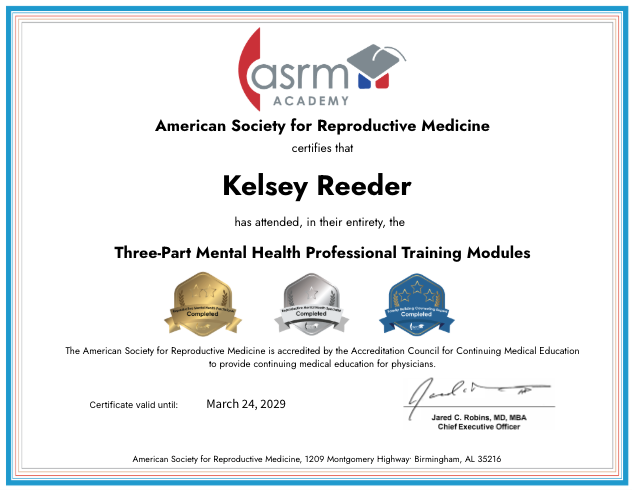
Certification Completion
MHPTM001: Mental Health Professional Training Modules Part 1: Basic Infertility, ASRM Academy
MHPTM002: Mental Health Professional Training Modules Part 2: Treatment Interventions, ASRM Academy
MHPTM003: Counseling for Contemporary Family Building, ASRM Academy
Use and Interpretation of the Personality Assessment Inventory (PAI) in Reproductive Medicine Workshop, Jones Foundation Infertility Counseling Conference
Nuts and Bolts of Donor and Gestational Carrier Evaluation, Dr. Carrie Eichberg, Psy.D.
Psychological Testing: Systemic and Standardized Assessment of Psychological Attitudes, Behavior, Personality Traits, Cognitive Abilities, and Emotional Functioning, Vista